You probably don’t think much about your inner ear until it stops working. This tiny organ, about the size of your pinky nail, helps you stay balanced every time you move your head. When it works well, you never notice it. When it doesn’t, everyday life can feel like standing on a boat.
“It is your primary balance organ, and it also helps with your hearing,” says Alek Angeli, PT, DPT, CCVT, a physical therapist and the lead neurologic specialist at Sky Lakes Medical Center. Angeli treats people with dizziness and balance problems every day.
What Is a Vestibular Disorder?
The vestibular system is the sensory system in your inner ear that controls balance, posture, and spatial orientation. It has five main parts: three fluid-filled semicircular canals that track head rotation and spinning movements, one small sac that senses horizontal movement, and another small sac that senses vertical movement.
Your inner ear senses when your head moves and sends that signal to your brain, eyes, neck, and legs so your body can react and stay steady. When that signal gets delayed, you feel dizzy.
Angeli says this shows up in a few different ways. True vertigo happens when tiny crystals inside your ear come loose and make the room feel like it’s spinning. Some people feel like their body is a step behind their head, especially when they turn quickly. And others feel faint when they stand up too fast, or just unsteady on their feet over time.
Sinus infections, ear infections, allergies, and head injuries can all put pressure on your inner ear and delay the signals it sends to your brain. Angeli also sees a lot of dizziness in older adults who have simply slowed down over the years. “That organ is just like any other muscle. If you don’t use it, you’ll lose it,” he says.
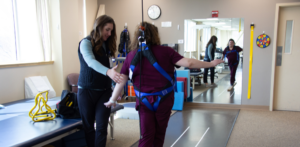
The good news is that vestibular therapy works, and it often works fast. Angeli builds a plan around your specific triggers, then has you practice the movements that cause trouble, starting seated, then standing, then walking, until your brain learns to trust those movements again. “Most patients within four visits will notice at least a 50% improvement in function,” he says. Simple cases can clear up in five or six weekly visits, while more sensitive cases may take eight to ten weeks.
Repetition is what makes therapy work. Angeli usually has patients doing their exercises at home a few times a day, in short sessions, so their brain gets plenty of practice. “The more repetition, the more practice they’re getting at it, the more their brain is going to home in on those exercises,” he says. He starts patients out safely in the clinic before sending them home with a routine, then adjusts the plan each week as they improve.
Angeli recalls two patients whose lives changed almost overnight. One man, a medically retired veteran, had lived with severe spinning episodes for 10 years after a grenade blast dislodged the crystals in his inner ear; a single repositioning session let him play with his kids and sleep beside his wife again for the first time in a decade. Another patient had lived with chronic dizziness for 22 years after being misdiagnosed; eight weeks of therapy resolved it completely.
Don’t Just Live With It
Many people assume dizziness is just part of getting older, but Angeli disagrees. “No one should be experiencing balance issues,” he says. If you feel unsteady, lightheaded when you stand, or queasy when you turn your head, talk to your doctor about a referral to vestibular therapy. You don’t have to accept feeling off-balance as your new normal.
 [gtranslate]